
What is BPMN? Business Process Model and Notation
Learn how Business Process Model and Notation (BPMN) helps align teams, empowers more creative problem solving, and speeds up development.
Collaboration starts with a shared understanding
Communication isn’t always easy to pull off—especially for modern teams that span roles, disciplines, and technologies. When business and IT speak different languages, it becomes difficult to capture how work actually gets done. Processes often cross departments, systems, and even external partners, creating a level of complexity that’s hard to visualize or align on.
That’s where Business Process Model and Notation (BPMN) comes in. As a universal language for describing business processes, BPMN turns complex operations into clear, visual models that everyone can understand. It gives teams a single source of truth for how work flows across people, systems, and decisions, bridging communication gaps and laying the foundation for smarter collaboration, automation, and continuous improvement.
What is BPMN?
Business Process Model and Notation (BPMN) was developed as a graphical notation to represent complex processes and address these challenges. The visual nature of BPMN enables greater collaboration between different teams, which isn’t surprising given that studies have shown that the human brain can process visuals 15.4 times faster than text.
BPMN enables teams to:
Get a clear vision of how a complex business process operates from end to end
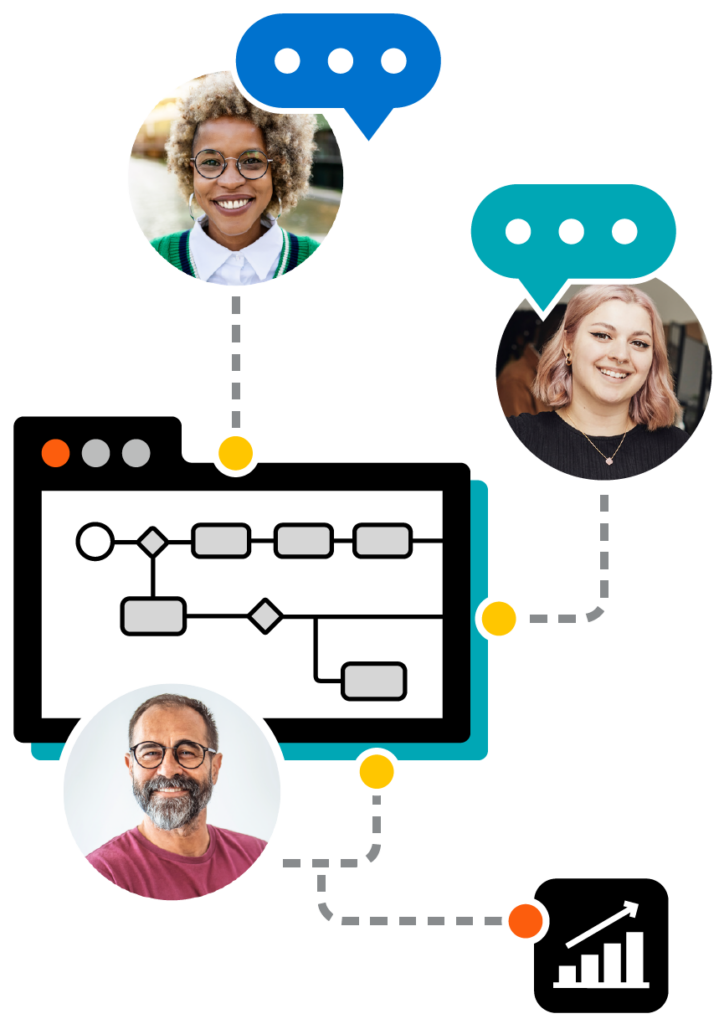
Get everyone on the same page with process models
Creating visual process models helps everyone better understand, discuss, and remember processes. Because BPMN represents a process graphically, people of different backgrounds and expertise can read the model.
Visually representing a complex process helps to break down barriers between what’s needed from the business and what’s technically feasible. It allows teams to agree on a chosen design before writing any code. From this foundation, teams can iteratively improve a process using data from the process itself.
Bring visibility to complex processes
Most employees have a limited understanding of the processes and workflows that keep their organization running. Their view typically covers their specific area of expertise, resulting in a fragmented picture of a process that can hinder collaboration and innovation.
BPMN tools should offer various ways to work on and share a process model to better enable cross-team collaboration. With the rise of distributed teams, having ways to design a model remotely (and asynchronously!) can greatly impact productivity and creativity.
Other examples include embedding a model directly on an internal webpage so everyone can understand how workflows run or sharing a process health dashboard. Providing an artifact also ensures that knowledge isn’t lost if the person who created the processes moves to a different team or business unit.
Turn expertise into innovation
Having a diverse set of people working together on the same problem produces more innovative results. Combining technical and non-technical teams to work through a challenge helps uncover gaps in knowledge and create a more holistic and innovative solution.
Developers typically are less interested in the monetary side of the business equation. They’d rather solve complex problems by writing code. But successful collaboration between both parties can be challenging without a simple way to map out and diagram a process.
BPMN can also help teams take a more agile approach to solve problems. You can quickly create a minimum viable product (MVP) solution that addresses the issue you’re trying to fix. From there, you can make data-backed improvements iteratively and deploy the newest version during the next development cycle.
This is where BPMN can help align different groups to better understand and represent a process design. Combining the visual nature of BPMN with a user-friendly way to model processes speeds up the creation of innovative solutions.
Streamline development efforts
Because BPMN can be made executable, a process can be fully designed before any development time is spent. Developers don’t have to waste time writing code that will be revised during a second iteration because everyone aligns on the scope and solution upfront.
Other benefits for developers include:
Less time needed agreeing on the scope of the process solution
Greater focus on implementing the business logic itself instead of routing and orchestration
Enhanced efficiency for process execution
Streamlined development efforts via reusable boilerplate code and Connectors
Out-of-the-box scheduler and durable state using a workflow engine with BPMN
Easier solutions to common engineering problems, such as applying the saga pattern
Reduced coding overhead with advanced symbols like timers, compensation, and gateways
Common workflow patterns BPMN helps solve
Business processes often have similar challenges regardless of the industry or use. As a result, there are several workflow patterns that can solve these problems. These patterns handle complex business process logic across multiple endpoints, such as executing process flows in parallel, message correlation, escalating events, or dealing with a fatal error.
BPMN diagram example
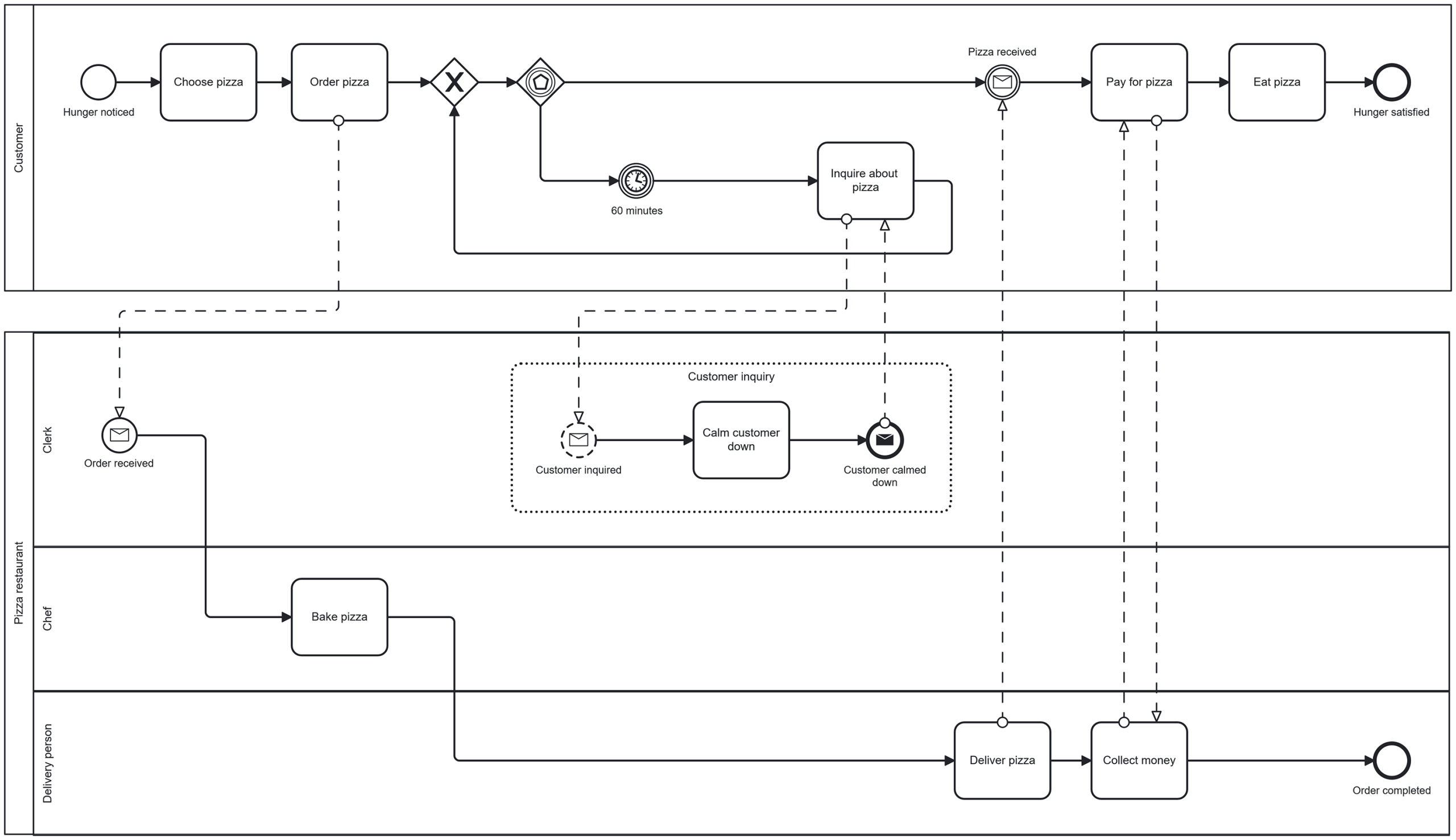
This is a frequently-cited BPMN example developed by OMG to show collaboration between various participants in a process. Because we want to explicitly model the interaction between the customer ordering a pizza, and the vendor who’s producing it, we instead classify them as participants and give each a dedicated pool.
BPMN pizza example
Advanced workflow pattern examples
Dynamic parallel execution
BPMN makes it easy to diagram and coordinate many concurrent tasks.

A simplified example: A customer of an e-commerce vendor purchases multiple items in the online store. During the order process we need to iterate over the list of placed items to make sure they are still available in the vendor’s warehouse.
These steps would also likely inform other systems in the business such as ERPs in finance, customer relationship software, or supply chain and logistics systems.
BPMN simplifies the difficult task of connecting unique identifiers and canceling process instances.
A simplified example: After attempting to cancel an order using their account portal, a customer calls the contact center for help. Unfortunately, the agent lacks details of what the customer already attempted, and doesn’t have a unique ID to reference and help resolve their issue.
Interrupting a workflow with hundreds of tasks spread across multiple distributed systems can be difficult to accomplish at scale without using BPMN and a workflow engine.
BPMN helps escalate a process if it’s not completed within an agreed window of time.
A simplified example: A professional services firm issues an invoice to a customer, and the invoice is not paid on time. An accounting software system prompts the customer to pay the invoice with an automated email coming from the service provider’s business email address.
In this case, the process is coordinated across both the firm’s business email and accounting system.
The perspectives of a wide range of businesses, from industries like financial services to public sector to telecom, provide a fascinating look into the ways BPMN adds value to an organization.

Three BPMN Myths Debunked
Folks who aren’t familiar with BPMN can sometimes feel overwhelmed by the volume of options. The nature of BPMN is that it can communicate complex workflows in a visual way, but to do so, requires a set of symbols.
The most common myths we hear about BPMN are that it’s:


Complex
The notation was designed to visually describe complex business processes that span various endpoints such as people, systems, and devices.
To accomplish this, it needs to handle just about any scenario. The result is a “visual language” that helps address process complexity and endpoint diversity through a library of human-readable symbols.
The visual nature makes the notation more accessible because anyone with a little time can pick up the symbols and understand how a process flows.
You can also learn iteratively without needing to recognize every symbol. This lets you start modeling processes with a basic symbol set before revising your models with more advanced complexity.


Difficult To Learn
Any new skill can feel difficult when you’re just starting.
Take your first programming language as an example. There were all these foreign commands, syntax, and specific rules you needed to follow but didn’t yet fully understand.
BPMN is often described as a visual programming language for similar reasons. It has a set of symbols and grammar that you’ll use to describe a complex process.
When learning anything new, it’s a balance of theory and practice that helps you get up to speed fast.
Because it is an open standard, there are plenty of educational BPMN resources available to help.
Obsolete
BPMN has a long history of use to automate business processes.
While some argue that the age of the notation shows that it’s obsolete, the reality is that it is a reliable and effective way to map complex business processes so they’re easier to understand and transform.
A 2022 study showcased how BPMN enhances the efficiency and efficacy of healthcare organizations, and improves patient outcomes while restraining costs.
Because it’s an open standard, BPMN knowledge can easily transfer to other organizations or technology solutions.
Additionally, the DMN (Decision Model and Notation), which is used to automate business decisions, boosts BPMN’s functionality so you can fully embrace the potential of your processes.
BPMN and Agentic AI
The flexibility of BPMN makes it a perfect fit for modern tech stacks, including organizations taking advantage of the latest innovations in AI and enabling agentic orchestration by developing AI agents. Camunda leverages the BPMN ad-hoc sub-process to blend deterministic and dynamic, AI-driven process execution. This means you can easily let the AI make decisions where it is capable of it, while maintaining clear guidelines around when humans should be in the loop.
BPMN provides the governed framework that agentic AI needs to operate safely at enterprise scale. By defining process boundaries, exception handling, and human decision points, BPMN gives AI agents the structure to act autonomously while preserving accountability and compliance. This makes it possible to design agent behavior—such as planning loops, contextual reasoning, and adaptive task selection—within a transparent, auditable process model.
BPMN also provides a bridge between static process logic and dynamic agent intelligence. It enables you to model multi-agent patterns, trigger event-driven sub-processes, and use memory or retrieval-augmented generation (RAG) as inputs to process decisions. BPMN allows AI agents, humans, and systems to collaborate fluidly—coordinating deterministic steps with flexible, AI-driven actions. The result is a process layer that is not only automated but adaptive, explainable, and continuously improving.
8 tips to quickly learn BPMN
Adding new skills to your toolkit is a continuous process for developers. There’s always a new technology or language that you can learn to improve your work experience. Because BPMN is an open standard, adding it to your skillset can bring new career opportunities you’d want to explore.
Below are some tips and best practices to learn BPMN and start quickly.
1. It starts (and ends) with an event
There are over 100 unique elements that make up BPMN. For some, that can be overwhelming to start with. Fortunately, you can begin by looking at just two groups of symbols; flow objects and connecting objects. From there, you can keep expanding your understanding by putting BPMN into practice by modeling processes with greater complexity and more advanced BPMN symbols.
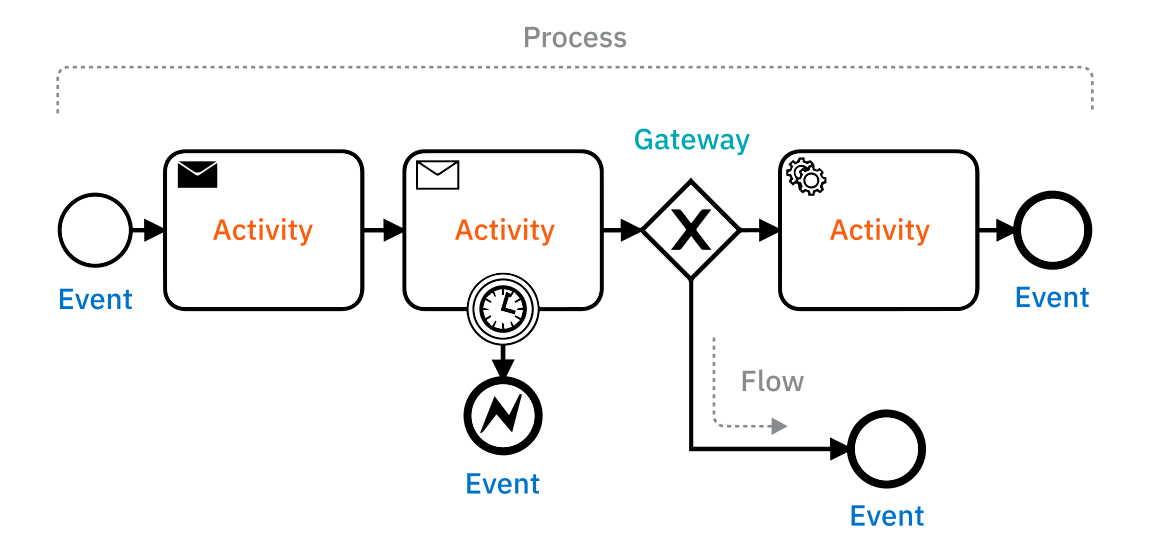
Events
Events mark something that happens during a process. They can start, interrupt, influence, or end a process flow. Start events trigger the beginning of a process, intermediate events modify or delay its progress (such as a timer or message), and end events indicate completion or termination. BPMN includes many event types, each with unique behavior and visual markers.
Activities
Activities represent the work performed within a process, either by humans or systems.
They can be simple tasks or sub-processes that group multiple steps together. BPMN also defines specialized activities, such as call activities (reusing another process), event subprocesses (triggered by specific events), and ad-hoc sub-processes (performed in no fixed order).
Gateways
Gateways control the flow of decisions or synchronization within a process. They determine which path the process will take. For example, an exclusive gateway (XOR) allows only one route, a parallel gateway (AND) runs paths simultaneously, and an inclusive gateway (OR) can follow one or more paths based on conditions. More advanced types, such as event-based gateways, wait for specific events before proceeding.
Flows
Flows connect and define the sequence and relationships between BPMN elements. Sequence flows show the order of activities, message flows represent communication between different participants or pools, and associations link artifacts such as data or annotations to flow objects. Together, these flows create a readable, executable model that mirrors how a real process operates across teams or systems.
Want to gain a full view of everything related to BPMN?
Download the first 40 pages of the best-selling BPMN book, Real-Life BPMN.
2. Use swimlanes to show responsibilities across processes
BPMN 2.0 defines two different types of swimlanes to partition responsibility for different parts of an end-to-end process: pools and lanes.
Pools act as a container to assign a set of tasks in a process and visually differentiate two or more independent processes. Pools contain lanes, which assign responsibility for subprocesses and tasks to show who is executing the tasks. BPMN calls this type of visualization a collaboration diagram.
Pools should be clearly named with the name of the end-to-end process, for example, Customer Onboarding. You can designate as many lanes as you’d like, but they always exist within a pool.
To get started quickly, you can eliminate pools and only use lanes by modeling the sequence as normal tasks. However, avoiding pools in your diagrams limits your ability to produce diagrams that can represent real-world complexity.
In practice, lanes are often used to assign:
- Positions in the organization, e.g., accounting clerk or logistics manager
- Roles in the secondary organization, e.g. data protection officer
- General roles, e.g. customer or end user
- Departments, e.g. sales
- IT applications, e.g. CRM system or legacy system
3. Watch how experts design complex business processes
4. Start with modeling a familiar process
The fastest path to learning something new is pairing theory with hands-on practice. It’s often easiest to start with a process that you’re already familiar with and that’s relatively simple. Another tip is to model a process that you may want to transform through automation to get a tangible benefit from your learning. The key is to start with a pilot project to keep your education focused and practical.
5. Understand process flows with token simulation
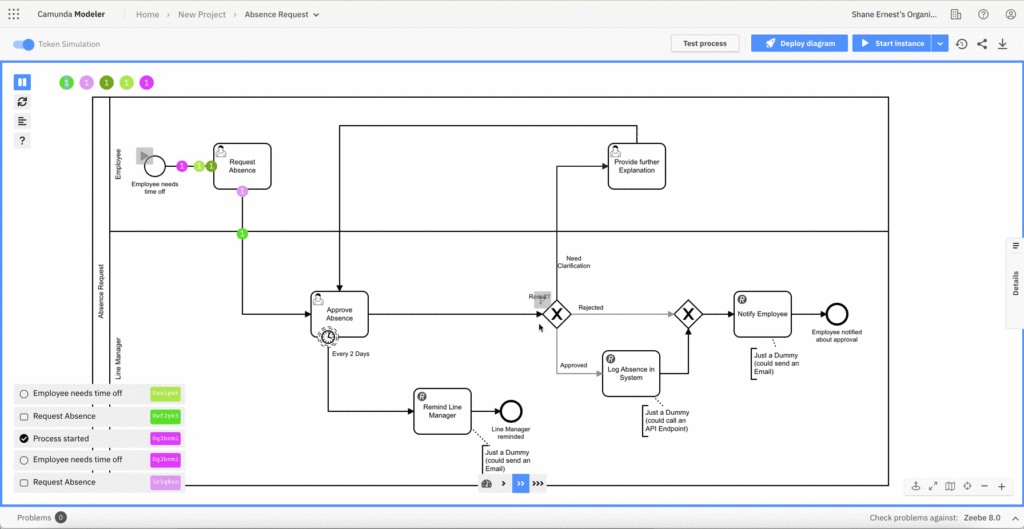
Complex models are hard to understand. You can follow the flows by hand, but it’s easier to use token simulation. You can turn gateways on and off to see how they interact with the workflow.
Not every BPMN modeling tool offers token simulation. Fortunately, we have it available in our Web and Desktop Modeler applications.
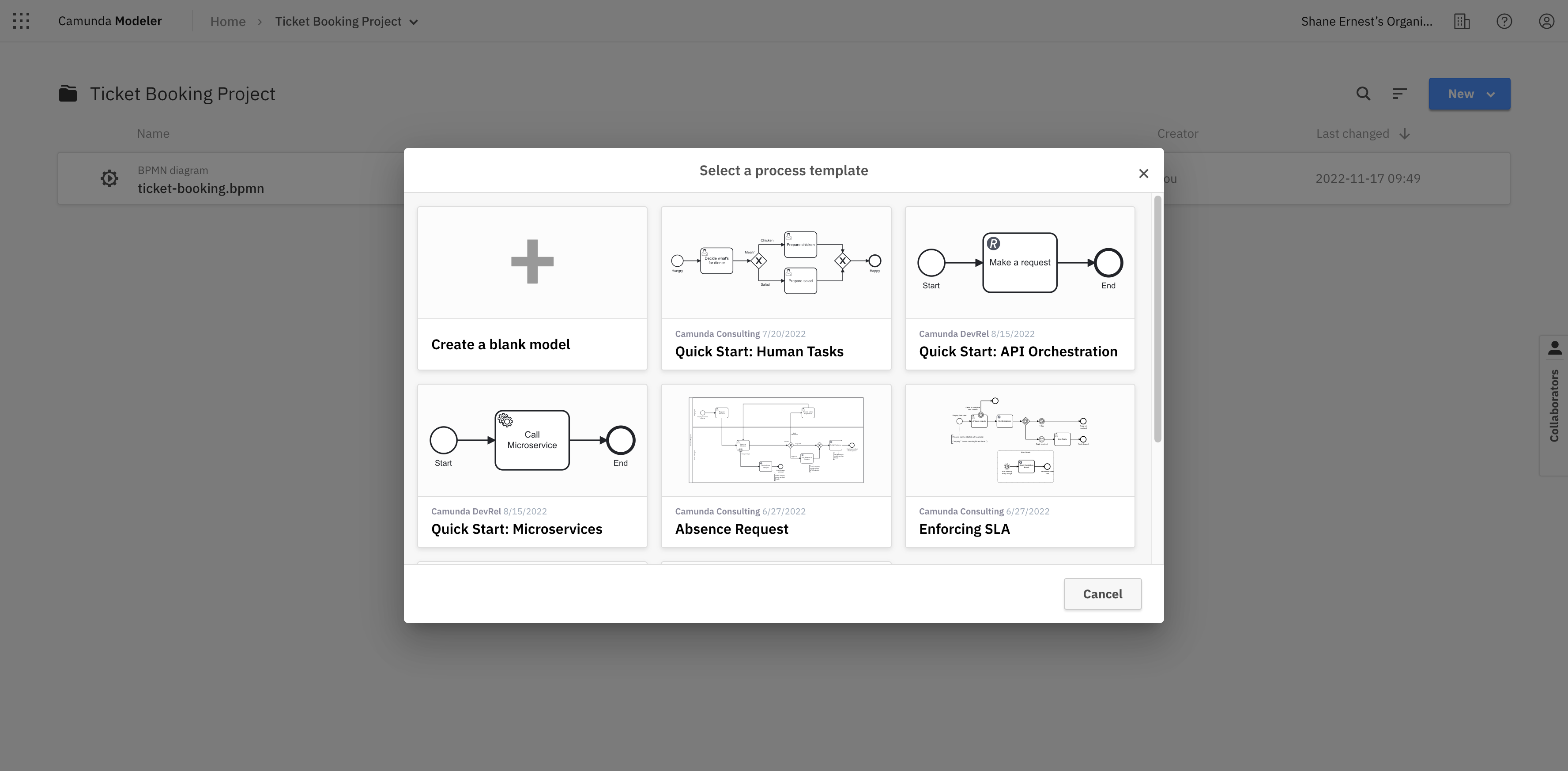
6. Get inspired with pre-designed and AI-assisted templates
Every business has uniquely tailored processes. Even the same process, such as a customer onboarding process, will completely differ in implementation and customer experience from one company to the next. This level of customization for common workflow patterns makes BPMN special.
Camunda Web Modeler offers a variety of quickstart templates as well as AI-powered copilots that can help you learn BPMN in Camunda. Copilots offer a starting place that you can customize to your specific needs.
7. Use AI to turn ideas into models fast
BPMN is highly adaptable, but as businesses face an ever-increasing pace of change, there is always pressure to move faster. Using generative AI to assist you in building models, as you can with our Camunda Copilot, can get you from a concept to a process diagram in moments.
Whether you are brainstorming ideas or have your exact list of requirements mapped out, you can now take advantage of AI to move faster than ever.
8. Learn BPMN online or in person
Because BPMN has a popular global following, there are several ways you can continue growing your expertise. Below are a few of our (semi-biased) favorites you can take advantage of.
Camunda Academy provides anyone with free, unlimited on-demand training on subjects like BPMN, DMN, and Camunda.
Join the Academy
BPMN in Action
The ultimate educational video series for BPMN tutorials. Review best practices, situation patterns, tips and tricks, and more.
Watch videos
Model for Free
Use Camunda Modeler for collaborative modeling using BPMN standards.
Create account
Frequently asked questions
What is BPMN?
Business Process Model and Notation (BPMN) is an open standard developed by the Object Management Group (OMG) for visually modeling business processes. It uses intuitive symbols to represent how work moves across people, systems, and decisions, making it easy for both business and IT teams to collaborate and improve process efficiency.
What are the main BPMN elements or symbols?
BPMN diagrams are built using standardized symbols for clarity and precision:
- Events show when something happens (start, intermediate, or end)
- Activities or tasks describe work that must be done
- Gateways control process flow such as decision, parallel, or inclusive paths
- Pools and lanes define participants and responsibilities
- Artifacts provide additional context such as data and annotations
What is the difference between a BPMN event, task, and gateway?
- An event is a trigger or result (such as a message or timer) that starts, interrupts, or ends a process
- A task is an action performed by a person, system, or AI agent
- A gateway is a decision point that determines which path the process follows next
What is the difference between BPMN and UML?
BPMN models business processes for operational clarity, while Unified Modeling Language (UML) models software structure and behavior. BPMN focuses on how work gets done, while UML focuses on how systems are built.
What’s the difference between BPMN and DMN?
BPMN defines how processes flow, while Decision Model and Notation (DMN) defines how decisions are made within those processes. They are complementary OMG standards and often used together to separate business logic from process logic.
Can BPMN be executed by a workflow engine?
BPMN models can be directly executed using workflow engines such as Camunda Zeebe, which interpret the BPMN diagram to automate end-to-end processes across systems, APIs, bots, and humans.
How does BPMN relate to process orchestration?
BPMN is the language of process orchestration. It provides the graphical and executable model that orchestrates how tasks, systems, and AI agents interact across an enterprise. In Camunda, BPMN models form the foundation for orchestrating humans, systems, and AI in one unified process.
What are common use cases for BPMN?
Organizations use BPMN to model and automate complex, multi-system processes such as:
- Customer onboarding
- Order fulfillment
- Claims and policy management
- Payment processing
- Regulatory compliance workflows
What are best practices for designing BPMN diagrams?
- Start simple, then refine collaboratively.
- Use clear names for activities and events.
- Avoid unnecessary gateways and loops.
- Keep swimlanes limited for readability.
- Validate models through simulation or testing before automation.
Can BPMN be used for AI or agentic automation?
BPMN is foundational for agentic orchestration. It provides the structure for coordinating AI agents, people, and systems in real-time. In Camunda, BPMN models can orchestrate LLM-powered agents, use retrieval-augmented generation (RAG), and enable multi-agent collaboration with transparency and control.



“With BPMN, I can show a flow to my business partner, and the business team can easily understand what’s going on. The technical team can understand what the implementation is, and we can model different errors and the process for recovering from these errors.”
Gustavo Arjones, CTO
Itau Unibanco