Introducing the Process Orchestration Maturity Model
Assessing the value of process orchestration to your organization's strategic automation efforts
Introduction: Process orchestration as a strategic imperative
Process orchestration is critical to accelerating automation, hyperautomation, and digital transformation alike, leading to greater efficiencies and better business outcomes. According to the 2023 State of Process Orchestration report, "96% of respondents believe that automation is critical to achieving their digital transformation goals."
To achieve these goals, many organizations adopted emerging automation technologies and tools, ending up with fragmented automation pieces loosely coupled with each other. At first, automating even a single part of a big process returned a lot of value, but eventually, a growing number of local solutions created more complexity to manage the whole end-to-end process. In addition, this hindered opportunities for optimization and improvement, leading to automation stagnation and declining ROI.
This happened because many business-critical processes are complex by nature.
According to 72% of the survey respondents, "real-world, business-critical processes are becoming more complex to maintain." That's because many of these processes consist of:
- Multiple steps
- A large number of different endpoints — including systems, people, devices, and even departments
- Workflows that need to be executed in parallel
- Situations that require exceptions handling
- And more.
In addition, according to McKinsey, "65% of smaller companies report success with automation, compared with just 55% at large organizations."

What is process orchestration?
Process orchestration and automation are closely related. Process orchestration coordinates the various endpoints of a business process, and sometimes even ties multiple processes together. Process orchestration helps you work with the people, systems, and devices you already have – while achieving even the most ambitious goals around end-to-end process automation.
Why process orchestration maturity matters
Over the past five years, organizations have accelerated their digital transformation efforts, adding new technology systems and processes to their mix at an unprecedented rate. In fact, software spending in this time period outpaced the general inflation rate by 4x. As organizations consider the impact of this spending spree, many are disappointed by how these new systems and processes lack alignment with their business goals. Undoing the high costs of transformational debt means considering how new technology fits in with the old. That includes how processes flow seamlessly from end to end — across people, systems and devices.
New software means new silos that impact internal efficiency, business agility, time-to-value, and customer experiences. Organizations who are not implementing process orchestration across these silos often experience:

Broken Customer Experiences
Broken or inefficient customer experiences

Process Inefficiency
Unnecessary inefficiency due to poorly identified, implemented, executed, and maintained processes

Lack of Visibility
An inability to measure effectiveness or continuously improve automated processes
To contrast, organizations that are highly mature in their process orchestration lifecycle implementations experience strategic, scaled adoption of end-to-end automation, aligned with their specific business goals and initiatives. According to Deloitte, 92% of advanced automation adopters leverage end-to-end automation as a part of their strategy now, or plan to do so in the next three years.
The result is achieving measurable business outcomes such as:
Let's take a closer look at the maturity model, and how your organization can advance in its process orchestration maturity.

Customer Experience
Marked improvements in customer experience, driving revenue opportunity

Internal Efficiency
Greater internal efficiency, lowering costs

End-to-End Automation
A higher degree of overall automation, driving digital transformation objectives
Inside the Process Orchestration Maturity Model
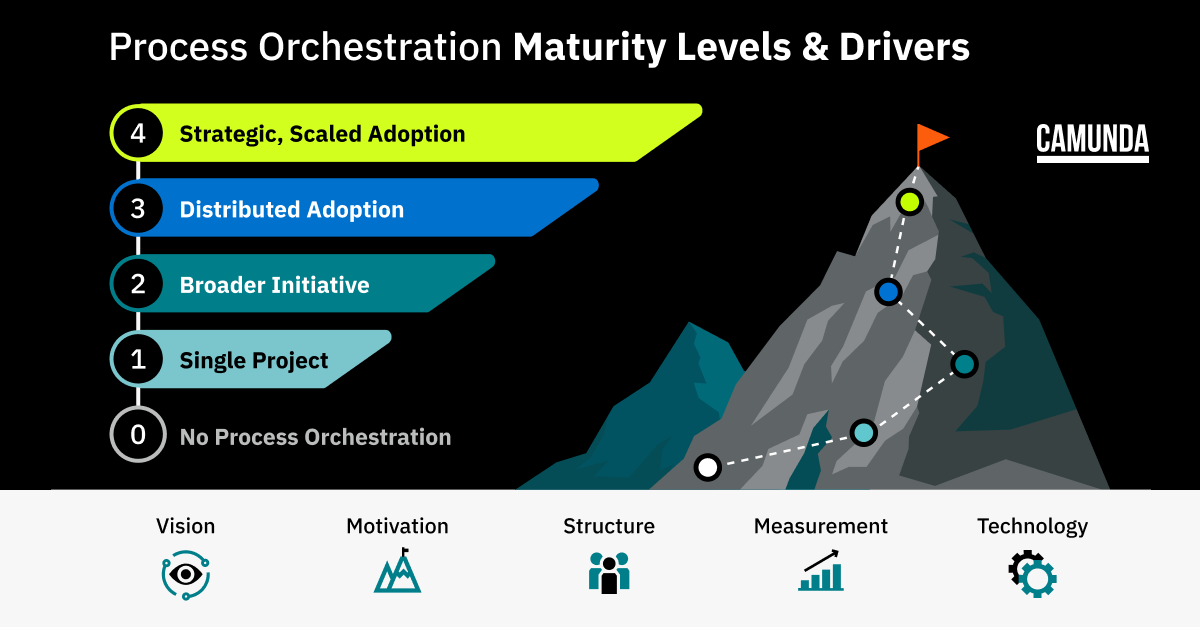
The Process Orchestration Maturity Model seeks to identify organizations' comfort levels and ability to execute process orchestration projects and strategies across a number of "drivers," or factors that help inform their maturity level. Improving maturity can help teams overcome the technology and people challenges standing in the way of meeting their automation goals.
All of these challenges negatively impact the business. Sometimes, more people need to get involved in what should be an "automated" process, adding unnecessary costs. Other times, inefficient processes and slow response times impact the customer or employee experience. Not to mention, many teams experience mounting legacy infrastructure maintenance costs.
Some common challenges might include:
- Lack of strategic oversight and visibility
- Legacy technology problems and growing technical debt
- A lack of integration capabilities
- Performance, reliability, and scalability problems
- And more.
To overcome these challenges and their resulting business impacts, organizations can assess their overall maturity by looking at where they stand relative to the model's five drivers of process orchestration maturity. By doing so, they can identify the key areas to focus their efforts to get the most value out of both new and existing digital transformation investments.
Process Orchestration Maturity Drivers

Vision
What is the awareness of process orchestration as a distinct competency in the organization? Why does it matter to the organization?

People
Who defines the standards and policies for how process orchestration should be used? Who is responsible for implementing these changes?

Technology
What technology philosophies, platforms, and solutions power the organization's process orchestration efforts?

Delivery
How are process orchestration and improvement projects and the teams meant to execute them set up and enabled for success?

Measurement
How does the organization define process orchestration success, and how capably can the organization track that success?
Level 0: No process orchestration
Level 1: Single project or ad-hoc use
Level 2: Broader initiative
Level 3: Distributed adoption
Level 4: Strategic, scaled adoption
Accelerating through the Maturity Model
Most organizations want to advance their process orchestration maturity to enhance specific business outcomes. Depending on the organization's sector or specific role, this might include improving:
Customer experiences
Compliance outcomes
Cost savings
Internal efficiency or team collaboration
IT modernization goals without disturbing business continuity
And more
Given organizations' varying priorities, advancement may look different for each team. However, organizations at each of the levels below may share these common characteristics as they accelerate in their maturity journey.
Level 0: No process orchestration
Organizations at Level 0 may be automating in silos with limited to no orchestration across processes, but have the most urgent need to implement process orchestration in some form.
They may find that a lack of orchestration reduces their operational ability to operate/execute, or hinders their ability to drive digital transformation. As such, this group is often the most motivated to break down silos that may negatively impact critical business outcomes.
These teams can focus on improving their ability to plan or act strategically or efficiently. Collaboration with business users on individual processes/projects or in training capabilities could be one specific area to improve.
Level 1: Single project or ad-hoc use
Organizations at this level of maturity are just beginning to realize how process orchestration can support their business needs on a project-to-project level.
They will need to invest the most resources into standing up the people, methods, and technologies needed to improve their mission-critical business processes and to understand how these efforts can drive further organizational value.
Level 2: Broader initiative
Organizations at this level of maturity have experienced some level of success with process orchestration, although this success may not have been measurable. They are beginning to question how to initiate broader process orchestration initiatives to bring more tangible value to the organization.
Maturity at this level may mean building their organizational strategy and establishing their team structures. However, they may still struggle with meaningful measurement.
Level 3: Distributed adoption
Organizations at this level of maturity are well on their way to using their process orchestration practice to drive business outcomes at scale across their organization. They have a clear understanding of the power of process orchestration, and are building out a roadmap to deliver bigger results faster across the organization.
They have the right personnel in place and are advancing maturity by working on the team structures and measurement practices that empower them to accelerate solutions across departmental silos and isolated business functions.
Level 4: Strategic, scaled adoption
Organizations at this level of maturity are delivering digital transformation due to their ability to drive better business outcomes. These outcomes are achieved in large part due to the organization's ability to deploy process orchestration at scale across the entire company. Sophisticated strategies, teams, and delivery methodologies have all combined to drive business outcomes and deliver value for the organization.
Even so, they understand that continuous improvement is necessary to achieving their ongoing process orchestration goals, and are focused on creating and implementing a feedback loop for improvements.

Visualizing the journey to orchestration maturity
Download the full PDF to access the complete maturity model framework, including the detailed 5×5 assessment matrix, driver descriptions for each level, and a self-assessment guide to identify your organization's current position.
Conclusion: Proving the value of process orchestration
As organizations advance through their process orchestration maturity journey, they gain full visibility and strategic oversight into their end-to-end processes, driving stronger alignment between business and IT. As a result, they can achieve greater automation outcomes faster, at lower cost, and with reduced risk. In other words, process orchestration maturity empowers organizations to achieve a culture of continuous improvement and adaptability toward any changes that arise.
According to Gartner, "Process orchestration is critical both to manage end-to-end customer journeys and to provide consistency of experience to the human workforce." It has emerged as a transformative strategy across sectors, empowering organizations to streamline operations, improve customer experiences, and drive sustainable growth. Embracing this approach positions organizations to thrive in an increasingly digital and competitive landscape.
With advanced maturity, the optimized use of process orchestration can drive organizations toward the ultimate goal of strategic, scaled adoption. These teams get more value from automation and orchestration efforts than their counterparts. Perhaps most importantly, their efforts are aligned with specific business outcomes, setting highly mature organizations apart from the pack in the path toward digital transformation success.
Learn more about process orchestration in The Process Orchestration Handbook
Explore the definition, benefits, and key concepts of process orchestration in our comprehensive guide — covering deterministic, dynamic, and agentic orchestration, common automation challenges, and how Camunda approaches enterprise-scale orchestration.