RPA that finishes the job
Your team built the bots. They click, copy, and clear queues every day. But cycle times, error rates, and SLAs only improve when bots are part of an orchestrated process. Camunda is that layer. Coordinate the bots you already run on any platform, or build new ones natively on Camunda. Either way, the process is in charge.
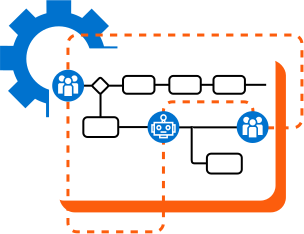
Get the outcomes your RPA investment was supposed to deliver
Bots handle the steps they were trained on. But cycle times, error rates, and SLAs depend on everything around those steps too: the exceptions that fall through, the handoffs that go quiet, the cases nobody can find when a regulator asks. Isolated bots don't fix that. An orchestrated process does.
Camunda is the layer that turns bot tasks into business outcomes. It coordinates the bots you already run on any platform, runs native bots on its own engine, and gives your team one place to see, measure, and improve every case end to end.
Key takeaways
- Bring the bots you already have, on any platform, or build native bots on Camunda.
- Real-time visibility into every case in flight, across bots, people, and systems.
- Reliable exception handling — cases don't disappear when something breaks.
- A full audit trail across every step, ready for regulators or internal review.
- Start by wrapping what already works. Replace what doesn't, on your timeline.
From tasks to outcomes
A bot can move data between two systems. That is real work, and it adds up. But your business doesn't get paid for moving data. You get paid for outcomes: the loan decision delivered in 24 hours, the claim resolved on the first call, the invoice paid before the deadline. Outcomes depend on the steps around the bot as much as the bot itself.
Camunda treats RPA as one piece of a larger flow. Bots become participants in a process you can see, measure, and improve. Every step, every exception, and every retry is captured against the case it belongs to, so SLAs get met and the team has one place to look when something goes wrong.
Coordinate the bots you already have.
Whatever runs your bots today (desktop runners, virtual machine fleets, cloud RPA, scheduled scripts), Camunda treats them as participants in your process. Bots fetch tasks from Camunda, do the work, and report back. The orchestration logic lives outside the bot, so you can change platforms, consolidate vendors, or run mixed fleets without rewriting how the process works.
- Bring bots from any RPA platform you already use, no rip-and-replace required
- Each bot becomes a step in an end-to-end process, alongside humans, AI agents, and systems
- Exceptions, retries, and timeouts handled by the process layer, not buried inside each bot
- Real-time visibility and a single audit trail across every case in flight
Or build them natively on Camunda.
Skip the second platform entirely. Build bots inside Camunda and run them on the same engine that orchestrates the rest of your business processes. One platform to learn. One control layer. One audit trail. Native bots are versioned, tested, monitored, and operated like every other part of the process.
- Author bot scripts in Camunda Modeler, deployed alongside your processes
- Same monitoring, same testing, same audit trail as everything else in Camunda
- No separate scheduler, no separate license, no separate dashboard
- Move bots to native execution incrementally, on your timeline
Wrap what already works, replace what doesn't
Most teams don't get to start clean. You have bots that mostly work, and the failures cluster in the same places: the screen that occasionally times out, the field that arrives in the wrong format, the case the bot was never trained on. Each one becomes a ticket your team has to chase down by hand.
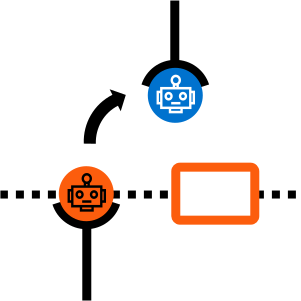
Augmentation is the easiest way in. Leave the bot in place and route it through a Camunda process that catches exceptions, hands them to a person or an AI agent for resolution, and resumes when the input is clean. You get visibility and reliability immediately, without rewriting anything.
From there, the path is incremental. More steps move into the orchestrated process. More bots become native. And as the underlying systems modernize and start exposing APIs, you can swap a bot for a direct API call without redesigning the process around it. Your team's investment compounds instead of being stranded.
What changes for the business
Most bot programs lose ground the same way: a vendor patch, a UI redesign, or a credential rotation, and nobody knows what's running, what stopped, or which case is now stuck. When the bot is part of a Camunda process, all of that becomes visible by default.
Real-time view of every case in flight.
See where each case is, how long it has been there, and which bot, person, or system is holding it up. SLA dashboards surface problems before customers notice them.
Learn more about observability →The work doesn't disappear when something breaks.
A crashed bot, a network blip, or a system outage will not lose the case. The process picks up exactly where it left off, every time. Your team stops chasing tickets manually.
Learn more about the orchestration engine →One traceable record of what happened.
Every step, every exception, every retry recorded against a single case. When a regulator or an internal review asks what happened, the answer is in the system and ready to share.
Learn more about governance →Your process is yours, no matter what changes underneath.
Camunda is built on BPMN, an ISO-ratified open standard. The way your processes work stays valid even if you change RPA platforms, swap AI models, or move bots between runners. Nothing gets stranded.
Learn more about BPMN →Bots, AI agents, and people
Camunda is one orchestration layer for bots, AI agents, people, and systems. RPA is no longer the only digital worker on your team. AI agents now handle exception cases and judgment-heavy steps that bots could never touch. People stay in the loop where stakes are highest. Bots continue to do what they do well: high-volume, predictable, repeatable work. Your team gets one place to manage the entire flow, with full governance and audit.
Bot estates, orchestrated end to end
Two enterprises with very different bot fleets, both running them through Camunda as part of a larger orchestrated process. Visibility, reliability, and audit come from the orchestration layer, not the bot platform underneath.
NatWest
Processing time saved. £3+ billion in financial transactions processed end to end, one million fewer sheets of paper, with bots and human steps coordinated inside the same Camunda process model.
Read the story →T-Systems Austria
Of manual work saved in a single year. Patch automation returned 8,500+ hours alone. VM provisioning dropped from weeks to under two hours, with bots, scripts, and approvals in one orchestration layer.
Read case study →Frequently asked questions
What is robotic process automation (RPA)?
What's the difference between RPA and process orchestration?
Is Camunda an RPA tool?
What are the typical use cases for RPA with Camunda?
RPA earns its keep where work touches a legacy system without an API, or where high-volume, rule-based steps drain your team's time. A few patterns come up again and again:
- Bridging legacy systems — Automate against ERPs, mainframes, and applications without APIs. Bots become the connective tissue between older systems and new processes.
- High-volume back-office work — Order changes, claims intake, customer data corrections, batch updates. The repetitive, predictable steps that absorb your team's bandwidth.
- Reconciliation and lookups — Compare reports, look up records, and resolve mismatches across applications that were never designed to talk to each other.
- Modernization in flight — Bridge old and new during a migration, then retire the bot for a direct API call once the new system is ready.