Governance for every process, every agent, every decision
Move AI agents from pilot to production with enterprise controls, full audit trails, and human oversight built into the same platform that runs your business processes.
The governance bottleneck
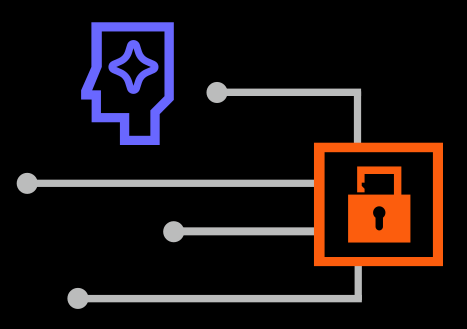
Every quarter brings new agents, new use cases, and new vendors. Few of them ship with the controls a regulated enterprise needs to actually run them in production. The EU AI Act and emerging global frameworks now require auditability, explainability, and human oversight for AI in production. Boards want measurable ROI from AI investments. Compliance teams want a clear answer to "why did this happen." Operations leaders want one view of every case in flight, whether it was handled by a person, an agent, or a system.
Without that, agents stay stuck in pilots. The blocker is rarely capability. It is governance. Camunda is the orchestration layer that closes that gap, so business teams move faster and the controls hold across every process and every agent.
- Agents proliferating without controlsMultiple frameworks, multiple vendors, no shared sequencing or approvals.
- Regulatory pressure risingEU AI Act, HIPAA, BCBS 239, and similar frameworks demand audit-ready records.
- No end-to-end audit trailMultiple contributors and systems with no single record of what happened.
Governance for orchestration, defined
Governance for orchestration is the set of controls that keep end-to-end business processes and AI agents safe, compliant, and accountable. In Camunda, governance is a property of the platform, not a layer added later. It covers three things at once: how processes coordinate across systems and people, how AI agents act inside those processes, and how every action is recorded for audit and improvement.
The result is a single source of truth: what you design is what runs, what you monitor, and what you improve next quarter. There is no translation gap between intent and execution, and no separate AI track that breaks when reality shifts.
Three layers of governance
Most platforms cover one layer. Camunda covers all three on the same model, so controls hold whether the next step is automated, agentic, or human.
Governance for end-to-end business processes
Camunda is the neutral orchestration layer that coordinates across CRM, ERP, ITSM, RPA, custom systems, and human teams. Policies, approvals, and SLAs are designed visually, executed deterministically, and monitored continuously. A claim, an onboarding, an order, or a payment runs as one process, not as a chain of disconnected automations. Compliance is enforced inside the flow, not bolted on after.
Governance for AI agents, outside and inside
From the outside, agents are coordinated as participants in a larger process: sequenced, escalated, handed off. From the inside, enforceable steps run between an agent's reasoning and its action. If an agent decides to issue a refund or send a high-value payment, a policy check or human approval can fire before the action executes. This inside-the-agent approach is covered by a US patent pending. It is what makes it safe to give agents real authority.
Built-in auditability
Every step, automated or agentic or human, is captured automatically. There is no extra logging system, no engineering ticket, no separate instrumentation project. When a regulator asks for the trail of a specific decision, the answer is one query away. New AI agents and new processes operate within existing controls from day one, with no governance rework required.
Guardrails your auditors and regulators recognize
Every guardrail maps to a concrete product capability. Not a policy document. Not a roadmap promise.
Least-privilege accessRole-based access control, SSO, and SCIM via Identity
Policy enforcementDMN decision tables, version-controlled and auditable
Human-in-the-loop approvalsMandatory review steps in Tasklist that no agent can bypass
Immutable audit trailsEvery step, decision, and override captured by Operate
Tool allow/deny listsInner-orchestration controls inject BPMN between agent reasoning and tool execution
Timeout & fallbackBPMN error events, compensation, and retry policies
Data-handling controlsConnector-level patterns enforce prompt and data redaction rules
Safe evolutionVersioned deployments, canary rollouts, and instance migration
Operate and Optimize
Two products turn governance from a checkbox into a daily practice.
Operate
The operational control room for processes and agents.
Operate gives operations teams a real-time view of every process and agent in flight. Teams can monitor work, intervene in stuck instances, replay from a failed step, and update agent behavior or process logic without taking the system down. When a customer asks where their case stands, the answer is on screen, not buried in a log file.
Optimize
Continuous improvement, powered by execution data.
Optimize turns every process run into evidence. Heat maps surface bottlenecks. SLA dashboards flag breaches before customers notice. Cost-per-case and cycle-time metrics tie agent activity directly to business outcomes, so teams can prove ROI and prioritize the next round of automation with data, not intuition.
One model, four jobs. The process model is defined in BPMN — the open standard for business process notation — which means it is readable by both business and technical teams without translation. Learn about BPMN → The same model is the documentation, the executable, the runtime view in Operate, and the analytics surface in Optimize. Business teams and IT work from a shared source of truth at every stage.
Proof from regulated industries
fewer compliance reports after deploying agentic orchestration with built-in approvals and audit trail.
finnova AGfaster claims processing. 30% lower cost per claim. Production deployment time cut from one week to one hour.
Norfolk & Dedham Grouperror reduction across AI-driven money transfers. 60% of transactions completed with no human correction.
Halkbank TürkiyeGartner
Visionary, 2025 Magic Quadrant for Business Orchestration and Automation Technologies. Recognized for agentic orchestration and vision.
Forrester
Strong Performer, Digital Process Automation Software Wave, Q3 2025. Rated 5/5 in orchestration and process standards.
In a highly regulated industry, it really helps us from an audit perspective. We can now see every single thing that happened on any order at any point in time, and that's absolutely critical for us.
Nicki Todd
SVP of Technology, First American
Different value across the table
Governance decisions are rarely made by one person. Here is what Camunda means for each of the people in the room.
Operations & line-of-business leader
Run faster, with controls you can stand behind.
Faster cycle times and lower cost per case, without trading away the audit trail or the policy checks your business depends on.
| Outcome | How Camunda delivers it |
|---|---|
| End-to-end visibility | One operational view across every process, every agent, every case in flight. |
| Audit-ready by default | Complete record of every decision (automated, agentic, or human) without extra instrumentation. |
| Built-in approvals | Policy checks and approval thresholds run on every case, every time, before any action executes. |
| Faster compliance answers | Trace any case in seconds. Cut the time spent responding to audit and compliance requests. |
| Continuous improvement | Optimize surfaces bottlenecks and SLA breaches so your team improves every week, not every annual review. |
Your team designs and improves processes visually. IT provides connectors, guardrails, and policy. Both sides work from the same model: what you design is what runs, and what you monitor is what you will improve next quarter.
CIO / CFO
AI investment that turns into operational metrics, not pilots.
You have funded the agents, the automation, and the transformation work. Camunda is the layer that turns those investments into outcomes your board can read: resolution time, error rates, cost per case, customer satisfaction. Governance comes built in. Vendor strategy stays open.
- Move AI from pilot to production with a full audit trail behind every decision
- Meet EU AI Act, HIPAA, BCBS 239, and audit requirements without custom instrumentation
- Avoid lock-in: BPMN logic and agent code are portable across vendors and infrastructure
- Proven at enterprise scale, including 9 of the top 10 US banks and 12M+ daily orchestrations across the customer base
Architect & developer
Open standards, distributed engine, agent-agnostic by design.
Camunda is built on BPMN, an ISO open standard. Orchestrate agents from LangChain, CrewAI, Dify, or your own frameworks via MCP and A2A protocol connectors. Build agents natively as ad-hoc subprocesses with explicit tool access and deterministic guardrails between the LLM and its actions.
The engine underneath is Zeebe: distributed, no central database, peer-to-peer brokers, built for processes that run for months without dropping state. Hot-deploy new versions while in-flight cases continue safely on the version they started on. Security, audit, and compliance controls are native, not a separate product.
Compliant, secure, and fortified for the enterprise
Camunda is a member of the Cloud Security Alliance and maintains SOC 2 Type II compliance, TISAX, and ISO/IEC 27001 certification. Read about our complete list of certifications and security practices in our Trust Center.
Visit the Trust Center
Frequently asked questions
What is governance in the context of orchestration?
Governance for orchestration is the set of controls that keep end-to-end business processes and AI agents safe, compliant, and accountable. In Camunda, governance covers three things at once: how processes coordinate across systems and people, how AI agents act inside those processes, and how every action is recorded for audit and improvement.
How does Camunda govern AI agents?
Camunda governs agents from the outside and the inside. From the outside, agents participate in larger processes with sequencing, approvals, and escalation. From the inside, enforceable steps run between an agent's reasoning and its action, so policy checks or human approval can fire before a refund, a payout, or an external action executes. This inside-the-agent approach is covered by a US patent pending.
Does Camunda support EU AI Act, HIPAA, and BCBS 239 compliance?
Yes. Camunda is used in financial services, insurance, healthcare, and government, where built-in observability, complete audit trails, and human-in-the-loop controls are non-negotiable. The platform supports EU AI Act, HIPAA, BCBS 239, and similar frameworks without custom instrumentation.
How does the audit trail work?
Every step in a Camunda process, automated, agentic, or human, is captured automatically. Operate provides real-time visibility into every case in flight. Optimize turns execution data into bottleneck analysis and SLA dashboards. When a regulator asks why a decision was made, the answer is one query away, with no separate logging system to maintain.
Is governance separate from the rest of the platform?
No. Governance is native to Camunda, not a bolt-on. Security, audit trails, and compliance controls are part of the platform from day one. New AI agents and new processes operate within existing controls automatically, with no governance rework required.
Can business teams change processes without weakening governance?
Yes. Business teams design and improve processes visually using the same model that runs in production. IT provides connectors, guardrails, and policy. Speed and control happen on the same platform, so business changes never bypass governance.